
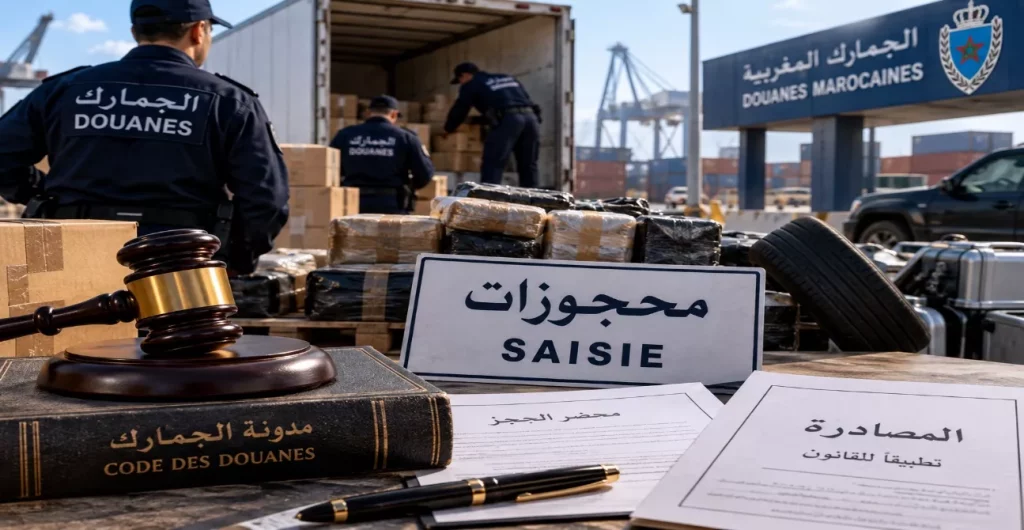
The legal regime governing customs confiscation under Moroccan law features distinct statutory mechanisms departing in key respects from ordinary criminal law. This specificity is evident in its composite legal nature, its in rem mandatory application, the categories of assets targeted, and the potential extension of forfeiture to innocent third-party property. Engaging a seasoned customs litigation and white-collar criminal defense attorney is vital to preserving legitimate property rights and upholding the fundamental principle of personal guilt.
This statutory structure generates critical legal issues whenever seized cargo or vehicles belong to a third party, particularly an innocent owner acting in good faith without knowledge or participation in the smuggling scheme. Balancing effective customs deterrence against the constitutional right to property is essential.
The Moroccan legislature addressed these questions in Articles 210 et seq. of the Customs and Indirect Taxes Code, complemented by authoritative Court of Cassation jurisprudence distinguishing accessory penalties from preventive in rem security measures.
What Principles Govern Customs Confiscation Under Moroccan Law?
Statutory provisions and judicial rulings establish the following fundamental principles:
- Confiscation lacks a single legal nature: it may operate as an accessory criminal penalty subject to personal culpability, an in rem preventive safety measure directed against the item itself, or civil compensatory damages depending on the nature of the property.
- Confiscation as an accessory penalty does not extend to assets owned by innocent third parties acting in good faith, provided the item is lawful per se and no specific statute provides otherwise (Supreme Court, Decision No. 2000/2728 of 12 October 2000).
- Confiscation as an in rem safety measure applies regardless of third-party ownership or good faith, even without criminal conviction, when the object itself is inherently unlawful or excluded from lawful trade (Court of Cassation, Decision No. 2019/532 of 20 March 2019, File No. 2018/4/6/13096).
- Neither third-party ownership nor bona fides provides absolute immunity; their legal effect depends on the nature of the sanction and statutory prerequisites.
- Specific customs rules prevail over general criminal law provisions.
- Contraband cargo is subject to broad in rem forfeiture under Article 211, irrespective of who holds it, even if owned by an unidentified entity or innocent party.
- Smuggled cargo, masking goods, and transport vehicles are each governed by separate, autonomous legal frameworks.
- Vehicles owned by third parties are subject exclusively to the strict statutory conditions of Article 212; mere use in an offense does not suffice for forfeiture.
- Courts must rigorously evaluate whether the vehicle was specially altered with secret cavities, the driver’s relationship to the owner, and whether authorized scope was exceeded.
- Customs confiscation is mandatory when statutory conditions are established, leaving judges no discretion for equitable waiver (Court of Cassation, Decision No. 2011/990 of 8 June 2011, File No. 2011/7/6/1236).
- Mandatory application does not mean automatic forfeiture: trial courts must substantiate all statutory elements before divesting private property.
- Impossibility of physical seizure leads to compensatory monetary substitute judgments under Article 213, valued pursuant to Article 219.
- Any confiscation judgment affecting third-party assets requires complete factual and legal justification.
I. Specific Nature and Scope of Customs Confiscation
Article 210 of the Customs Code differentiates between prohibited goods (preventive safety measures) and lawful goods (civil compensation). While smuggled goods face mandatory in rem seizure under Article 211, concealment merchandise (Article 211 bis) and transport vehicles (Article 212) follow dedicated protective pathways. Inability to seize triggers cash compensation under Article 213, joint liability under Article 231, and formal settlement under Article 273.
II. Forfeiture of Third-Party Vehicles and Good Faith Safeguards
Because motor vehicles are inherently lawful assets, Article 212 establishes that third-party vehicles are exempt from confiscation unless specially customized with hidden smuggling compartments or operated with proven owner authorization and knowledge. Defending innocent titleholders represents a direct statutory challenge under Article 212, supported by landmark rulings (Decision No. 2000/2728 and Decision No. 2019/532).
III. Mandatory Forfeiture and Jurisprudential Boundaries
Although statutory forfeiture is mandatory once established (Decision No. 2011/990), trial courts remain legally bound to demonstrate specific compliance with all Article 212 criteria rather than relying on generalized assertions of vehicle involvement.
Conclusion and References
Customs confiscation is compulsory only where expressly mandated and factually proven; its in rem nature does not override constitutional protections for innocent third-party owners.
Legal and Jurisprudential Authorities
- Statutory Authorities: Moroccan Criminal Code; Customs and Indirect Taxes Code (Articles 210, 211, 211 bis, 212, 213, 217, 219, 231, 273 et seq.).
- Jurisprudence: Supreme Court Decision No. 2000/2728 (12 Oct 2000); Court of Cassation Decision No. 2019/532 (20 Mar 2019, File No. 2018/4/6/13096); Decision No. 2011/990 (8 June 2011, File No. 2011/7/6/1236).
Frequently asked questions
Can customs authorities forfeit a commercial vehicle owned by a third party?
No, a vehicle belonging to an innocent third party is exempt from forfeiture unless specifically altered with smuggling caches or used with proven owner complicity.
How does cargo forfeiture differ from vehicle confiscation?
Smuggled contraband is forfeited automatically in rem, whereas vehicles require satisfying stringent statutory conditions safeguarding genuine titleholders.
This article is general information, not legal advice. Every matter has its own facts and calls for its own assessment.